Annals of Neurosciences, Vol 12, No 4 (2005)


Annals of Neurosciences, Volume 12, Issue 4 (October), 2005
ANTIOXIDANT EFFECTS OF ASPARAGUS RACEMOSUS WILD AND WITHANIA SOMNIFERA DUNAL IN RAT BRAIN
Corresponding author
Dr. Maheep Bhatnagar,
Dept. of Zoology, MLS University Udaipur-313001.
Email:
Abstract
Asparagus racemosus Wild (shatawari) and Withania somnifera Dunal (ashwagandha) are rasayana commonly used in Indian traditional Ayurvedic medicinal system. Shatawari roots are used as tonic especially during pregnancy, gynecological disorders like menorrhagia and to increase lactation. Withania somnifera Dunal, is primarily used in ayurvedic preparations as powder, decoction, medicated wine etc., though primarily roots but seeds and leaves are also used for medicinal purposes. Present investigation was carried out with an aim to investigate the antioxidant properties of these plants using rat brain hippocampus as model system. Results of the present study demonstrate antioxidant effects of the root extracts of both Asparagus racemosus (Shatawari) and Withania somnifera (Ashwagandha) in rat hippocampus used as model system. These effects are evidenced by significant recovery of SOD and CAT enzyme level after drug treatment to the animals given 4hrs immobilization/swim daily up to 30 days, in unpredictable manner. These enzymes are part of antioxidant defense of the body against free radicals and thus the significant increase after the drug treatment is indicative of free radical scavenging properties of both the drugs used in study. A significant increase in LDH activity after stress but significant decrease after drug treatment is indicative of reduced lipid peroxidation in the brain area studied.
Key Words: Asparagus racemosus, Withania somnifera, antioxidant
Introduction
Asparagus racemosus Wild (shatawari) and Withania somnifera Dunal (ashwagandha) are rasayana commonly used in Indian traditional Ayurvedic medicinal system. Shatawari roots are used as tonic especially during pregnancy, gynecological disorders like menorrhagia and to increase lactation (1). Its hormonal influences are best manifested in conjunction with female sex hormones (2). Presence of isolflavones in Shatawari are responsible for its estrogenic characteristics (3). It is also described as a rejuvenator and nervine tonic. Authors have examined the cintioxidant effects of crude extract as well as purified polysaccharide fraction of A. racemosus (4–8). Withania somnifera Dunal, is primarily used in ayurvedic preparations as powder, decoction, medicated wine etc., though primarily roots but seeds and leaves are also used for medicinal purposes. The main pharmacologically active constituents are alkaloids and steroid lactones. Among alkaloids withaine, cuscohygraine, tropane, anahygraine, somniferrin, anaferine, withaminine, withaninine, while among lactones are withanoloids (9). Experimental evidences show that drug is useful in preventing senile dementia and Alzheimer's disease. Authors studying foot shock induced changes in the rat brain showed that ashwagandha also normalizes SOD and LPO activity and enhances CAT and GPX activity (10,11).
Present investigation was carried out with an aim to investigate the antioxidant properties of these plants using rat brain hippocampus as model system.
Materials and Methods
Animals: Adult Swiss albino rats were used for the present study (BW 165±5 gm). They were placed in animal room for seven days in polyutherine cages to acclimatize the laboratory conditions. All the rats were given food and water ad-libitum and were maintained at 12 : 12 hour light and dark cycle at 27+2°C. Prior to start of the experiment animals were divided into control and experimental groups.
Control group: Rat (n= 4) were kept in pathogen free environment in isolated room. Room was locked for 24 hours. Rats were provided enough food and water. Animal room is locked for 24 hrs. This exercise was necessary to avoid any stressful situation because of handling or noise.
Experimental group: Rats were divided into three experimental groups.
E1 (Stress) group: Rat (n=6) were given 6 hours unpredictable stress daily for 30 days.
E2 (Stress+ dose) group: Rat (n=6) was given 6 hours unpredictable stress and simultaneously treated with the methanolic extract of A. racemosus (100 mg/kg of BW).
E3 (Stress +dose) group: Rat (n=6) was treated with methanolic extract of W. somnifera (100 mg/kg BW).
Stress protocol: All the animals of Group E1, E2 and E3 were subjected daily to restraint and swim stress alternatively in unpredictable manner up to 30 days. Animals were either forced to swim, or live in tightly fit container for 6 hours between 9:00 - 2:00 pm. Colonic/Rectal temperature was measured every day immediately before and after stress and other hyperactivities were also recorded for stress determination e.g. prostration, salivation etc. Stomach was dissected out to observe hemorrhagic spots as well. Beside this, daily record of food and water intake was also maintained for all the groups.
Drug preparation
Roots of A. recemosus and W. Somnifera were purchased from local supplier. Dried roots were purified using absorption method, by keeping them in contact with brick powder. After purification, the roots were powdered. Finally, packed in filter paper and extract was prepared by continuous extraction method in soxhlet extractor using methanol as solvent. After vacuo-evaporation powder extract was dissolved in CMC.
Dose schedule
Rats (Group F2 and E3) were given daily drug extract dose of 100 mg/kg of BW dissolved in CMC before 1 hour of starting stress regimen. Dose was administered orally (using feeding tube). Treatment was continued for 30 days.
Biochemical analysis
Animals were sacrificed by decapitation. Only fore brain was selected for the study. Brain was quickly dissected out and placed in ice cold phosphate buffer saline. Tissue were palpated to remove the blood and then dissected on the ice chilled glass plate. The hippocampus was dissected out under stereo microscope. Tissue was pooled from 2 animals and was weighed, then chopped into small pieces and transferred to homogenizer tube. Cold 100mM phosphate buffer (pH 7.2) was added. Tissue was grounded in Teflon mechanical homogenizer. The homogenate was diluted 10 times and spun at 10,000 rpm for 15 minutes. Supernatant was used for enzymatic assay.
Enzyme assays
All the biochemical estimations were carried out according to established and standardized protocol. Ascorbic acid was assayed using Natelson (12). Superoxide dismutase (SOD) enzyme was measured using NBT method of Winterbourne et al (13). Catalase (CAT) was assayed colorimetrically by the method of Sinha (14). Malondialdehyde (MDA), an end product of lipid Peroxidation was assayed by Buege and Aust (15). Lactic dehydrogenase (I DM) was measured by method of weishaar (16).
Results
Superoxide dismutase (Fig.1): SOD level in stress group brain (hippocampus) significantly decrease (P< 0.001) as compared to control group. Treatment with A. racemosus extract as well as treatment with W. somnifera root extract showed significant (P< 0.001) recovery of the enzyme activity. CAT Level (Fig.2) also decrease significantly (P< 0.001) in stress group as compared to controls. Like SOD , CAT activity also showed significant recovery after treatment with A. racemosus root extract (P< 0.001) and W.somnifera root extract (P< 0.01). MDA level also increased significantly (P<.0.001) in stress group (Fig.3). After treatment with root extracts of A. racemosus (P< 0.001) and W.somnifera (P< 0.01) significant decrease in MDA level was observed. Ascorbic acid level (Fig.4) also decrease significantly (P< 0.001) in stress group. After drug treatment it shows significant recovery (P< 0.001). LDM level increased significantly (P< 0.001) after stress treatment (Fig.5). After treatment with root extracts of A. racemosus and W .somnifera both, a significant decrease (P< 0.001) in LDM activity was observed.
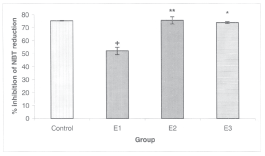
Fig-1 : Effect of stress and drug treatment on Super oxide dismutase activity (Mean ± SEM) in hippocampus.
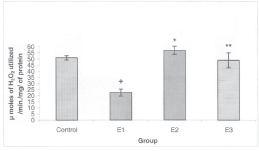
Fig-2 : Effect of stress and drug treatment on Catalase activity (Mean ±SEM) in hippocampus.
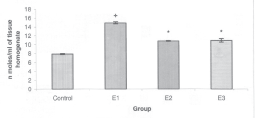
Fig-3 : Effect of stress and drug treatments on malonaldehyde level (mean ±SEM) in hippocampus.
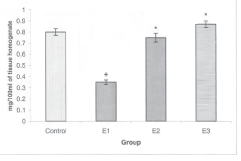
Fig-4 : Effect of stress and drug treatment on ascorbic acid level (Mean ± SEM) in hippocampus.
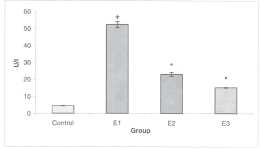
Fig-5 : Effect of stress and drug treatment on LDH (Mean ± SEM) inhippocampus.
Discussion
Results of the present study demonstrate antioxidant effects of the root extracts of both Asparagus racemosus (Shatawari) and Withania somnifera (Ashwagandha) in rat hippocampus used as model system. These effects are evidenced by significant recovery of SOD and CAT enzyme level after drug treatment to the animals given 4hrs immobilization/ swim daily up to 30 days, in unpredictable manner. These enzymes are part of antioxidant defense of the body against free radicals and thus the significant increase after the drug treatment is indicative of free radical scavenging properties of both the drugs used in study. A significant increase in LDH activity after stress but significant decrease after drug treatment is indicative of reduced lipid peroxidation in the brain area studied. Determination of MDA level also showed similar results and thus substantiate our observations. High MDA level is indicative of higher lipid peroxidation as observed in stress treated group. Significantly reduced MDA level after treatment with drug extract is clearly indicative of anti oxidant activities of these drugs. Ascorbic acid content is indicative of primary stress reaction and its lower level indicate high corticosterone secretion which has destructive effects on neuron cell bodies in hippocampus. In our study, lower concentration of ascorbic acid after stress treatment suggest detrimental effects on neuron cell bodies in hippocampus. Such effects were observed in cresyl violet preparation as acid phosphatase staining (published elsewhere). Thus higher ascorbic acid level observed after treatment with the extracts of both the drugs clearly demonstrate there corticosterone lowering capacity. Whether the endogenous elevation of glucocorticoids after stress is involved in decrease of antioxidant capacity of the nerve cells in brain. The results of the present study substantiate the above view. In fact, elevated levels of endogenous glucocorticoids during aging and chronic stress have been shown to induce nerve cell degeneration in hippocampus via increasing oxidative stress (17–21).
Application of herbal preparations as anti stress and cytoprotective agents has been attempted in past. Protection of hippocampal, cortex and striatum neurons after stress related degeneration has been reported in literature (11,22–25). Although on basis of these observations actual mechanism of the cell degeneration by stress regimen or protective effects of drug treatment can not be elucidated, however, study does suggest that A. racemosus as well as W. somnifera possess antioxidant properties however, our results indicates first time that the A. racemosus root extract shows more protective effects as compared to W. somnifera. Adaptogenic herbs have traditionally helped prevent the imbalances that can result from stress and thus may prevent or slow down the development and progression of the CNS disorders. In an Ayurvedic system of traditional medicine in India, Medya Rasayana is a group of herbal preparations known for their effects on nervous system. Few of them are also classified as adaptogen.
| Group | Treatment | Catalase μ Moles/ml/mg of protein |
(MDA) nMoles/ml |
SOD% Inhibition of NBT reduction |
Ascorbic Acid Mg/100 ml |
LDH U/l |
|---|---|---|---|---|---|---|
| I | Control(Vehicle) | 51.00 ± 1.73 | 7.90 ± 0.15 | 75.48 + 0.27 | 0.80 ± 0.03 | 4.50 ± 0.17 |
| II | Stress E1 (Swim) One Month |
22.50 ± 2.89+ | 14.94 ± 0.26+ | 52.09 ± 2.89+ | 0.35 ± 0.02+ | 52.35 ± 1.82+ |
| III | Asparagus racemosus E2 100 mg/kg/day |
57.25 ± 3.32* | 10.85 ± 0.10* | 75.59 ±2.80** | 0.75 ± 0.04* | 23.08 ± 1.17* |
| IV | Withania somnifera E3 100 mg/kg/day |
49.00 ± 6.06** | 10.98 ± 0.40* | 73.94 ± 0.76* | 0.87 ± 0.03* | 15.30 ± 0.23* |
All values represents Mean ± SEM (n=4)
P values: + < 0.001; ++ <0.01; +++ < 0.05 When compared with control
Untreated animals. *< 0.001; ** < 0.01; *** < 0.05 When compared with stress animals.
References
1. Hemadri KR. Leucorroheae and menorrhagia. Tribal medicine. Ancient Sci Life 1983; 3:40–41.
2. Ray DMM, Dhawan BN, Mehrotra BN. Screening of Indian plants for biological activity part I. Indian J ExpBiol 1968; 6 : 232.
3. Saxena VK, Chaurasia SA. A new isoflavone from the roots of Asparagus racemosus. Fitotherapia 2001; 72: 307–309.
4. Dutt VC. Materia medica of Hindus,Varanasi; Chowkumbha Saraswatibhawan, 1980; 148–149.
5. Singh V, Pandey RP Ethnobotany of Rajasthan. Scientific Publishers, Jodhpur, 1988; pp. 51.
6. Govil JN. Current concepts of multidiscipline approach to the medicinal plants (part-2). 1998.
7. Silvarajan VV, Balachandran I. Ayurvedic Drugs and their plant sources. Cited in: Uno H, Taran R, Else J, Suleman M, Sapolsky R:(1989); Hippocampal damage associated with prolonged and fatal stress in primates. J Neurosci. 1999; 9: 1705–1712.
8. Kamat JR Boloor KK, Devasagayam TPA, Venkatchalam SR. Antioxidant properties of Asparagus racemosus against damage induced by radiation in rat liver mitochondrion, J Ethonoparmacol 2000; 71 : 425–432.
9. Sharma P and Dandiya PC. Withania somnifera Dunal- present status. Indian drugs 1992; 29: 247–253.
10. Nadkarni KM. Popular Prakashan, Bombay. Vol. I Ind Materia Medica, 1976; 1292–1294.
11. Bhattacharya A, Ghosal S and Bhattachrya SK Anti-oxidant Effects of Withania somnifera glycowithanoids in chronic footshock stress induced perturbations on oxidative free radical scavenging enzymes and lipid peroxidation in rat frontal cortex and striatum. J Ethanopharmacol. 2001; 74: 1–6.
12. Natelson S. Technique of clinical chemistry 3rd Ed., Charles C Thomas, USA 1971; 286.
13. Winterboume CC, Hawkins RE, Brian Mand Carrel RW. The estimation of red cell superoxide dismutase activity. J Lab Clin Med 1975; 85: 337–341.
14. Sinha AK. Colorimetric assay of catalase. Anal Biochem. 1972; 47: 389–391.
15. Buege JA Aust SD. The Thiobarbituric acid assay. Methods in enzymology 1978; 52:306.
16. Weisshaar D. et.al, The photometric determination of LDH Med Welt 1975; 387.
17. Halliwell B. Gutteridge JMC. Oxygen radicals and nervous system. TINS. 1985; 8 : 22–25.
18. Sapolsky R. Pilsinelli W. Glucocorticoids, potentiate ischemic injury to neurons; Therapeutic implications. Science. 1986; 229 : 1397–1400.
19. Gould E, Woolbyey C, McEwen S. Short term glucocorticoid manipulation affect neuronal morphology and survival in dentate gyrus. Neurosci. 1990; 37: 367–375.
20. DeKloet ER. Brain, corticosteroid receptor balance and homeostatic control. Front Neuroendocrinol. 1991; 12: 95–164.
21. Behl C, Davis JB, Lesley R and Schubert S. Hydrogen peroxide mediates amyloid beta protein toxicity. Cell. 1994; 77: 817–827.
22. Bhattacharya SK, Bhattacharya A, Kumar A and Ghosal S. Antioxidant activity of B. monniera in rat frontal cortex, striatum and hippocampus. Phyto Res. 2000: 14: 174–179.
23. Bhatnagar M, Shukla SD, Jain S, Mundra A. Cytoprotective effects of Shankhpushpi an E. alsenoids preparation on hippocampal cells in mice. Ind Drugs. 2000; 37: 280–285.
24. Jain S, Shukla SD, Sharma K. and Bhatnagar M. Neuropretectective effects of Withania somnifera Dunn, in hippocampal sub regions of female albino rats. Phytotherapy research. 2000; 15: 544–548.
25. Shukla SD, Jain S, Sharma K and Bhatnagar M. Stress induced neuron degeneration and protective effects of semecarpus anacardium Linn. And Withania somnifera Dunn, in hippocampus of albino rats: An ultrastructural study Indian J of Experimental Biology. 2001; 38: 1007–1013.
26. Sapolasky RM, Kerry LC, McLewin BS. The adrenocortical stress response in the aged male rat; impairment of recovery from stress. Exp. Geronotol. 1983; 18: 55–56.
27. Sapolsky R. A mechanisms for glucocorticoid toxicity in the hippocampus: Increased neuronal vulnerability to metabolic insults. J Neurosci. 1985; 5: 1227–1234.
28. Uno H, Taran R, Else J, Suleman M and Sapolsky R. Hippocampal damage associated with prolonged and fatal stress in primates. J Neurosci 1989; 9 : 1705–1712.
29. Kerr DS, Campebell IW, Applegate M, Bredish A. and Landfield PW.: Chronic stress induced acceleration of electrophysiologic and morphometric biomarkers in hippocampal aging. J. Neurosci 1991; 11 : 1316–1324,
30. Sharma HS, Jorge CN. and Prasanta KD. Acute heat exposure cause cellular alteration in cerebral cortex of young rats. Neuroreport. 1991; 2: 155–158.
31. Olanow CW. Anders GW. Metals and free radicals in neurodegeneration. Curr Opi Neurol 1994; 7: 548.
(c) Annals of Neurosciences.All Rights Reserved