Annals of Neurosciences, Vol 16, No 4 (2009)


Annals of Neurosciences, Volume 16, Issue 4 (October), 2009
Protective effects of graded doses of Gabapentin on Aminophylline-induced experimental status epilepticus in mice
Corresponding Author
Chanda Kulkarni,MD, Ph.D, FSASMS
ABSTRACT
Background: Methylxanthines routinely consumed as beverages and available over the counter, are popular as Central Nervous System [CNS] stimulants and are potentially ictgenic in higher doses. Clinically such seizures are reported to be resistant to treatment with conventional anti-epileptic drugs [AEDs] and may be fatal. Purpose: Present study evaluated the effects of gabapentin in aminophylline-induced recurrent generalized seizures [RGSs] which is a model of human status epilepticus[SE]. Methods: The protective effects of increasing doses [100, 200, 500 mg/kg] of gabapentin [GBP] administered by intraperitoneal route[i.p.] were tested on aminophylline [AMPH]-induced [280 mg/kg] seizures in male albino Swiss mice. Results: Results showed a significant delay in the onset of myoclonic jerks and tonic seizures [p < 0.02 top < 0.0001], in mice pretreated with GBP at doses of 100,200,500 mg/kg, when compared using Post Hoc Mann-Whitney test. Mice treated with AMPH alone demonstrated mortality in 80% animals within 120 minutes and remaining 20% in 24 hr, while mice pretreated with GBP at doses of 100,200,500 mg/kg, showed reduction in mortality to 20%, 22.2% and 30%, in 120 min[p<=0.12]; and 80%, 77.8% and 40%, in 24 hr. Conclusion: The present study using single, doses of GBP showed incomplete protective effects, against AMPH-induced convulsions indicating partial protective effects of GBP. Data on mortality demonstrates fatal outcome of AMPH-induced convulsions depicting human status- epilepticus [SE]. Further studies involving chronic administration of GBP alone and in combination with other AEDs, to evaluate complete protective effects against 24 hr mortality, may be suggested.
doi: 10.5214/ans.0972.7531.2009.160404
Key Words
Aminophylline
Convulsions
StatusepilepticusGabapentin
Mortality
Introduction
Clinical data indicate, that intravenous aminophylline[AMPH] can induce repetitive generalized convulsions in patients undergoing intensive anti-asthmatic therapy and are often resistant to either single or high dose and/or combined anticonvulsant therapy.1, 2 Therefore the treatment of AMPH-induced convulsions still remains empirical. Occurrence of such seizures is not only reported to be associated with high serum AMPH concentrations but also at therapeutic or lower concentration range.3
GABA, an inhibitory neurotransmitter widely distributed in the CNS, cannot cross blood brain barrier. Gabapentin [GBP], an amino acid, designed as a simple analog related to GABA, is claimed to have anti-epileptic activity and sufficient lipid solubility to penetrate the blood brain barrier. GBP is reported to exhibit protective effect against several animal models of seizure including chemically induced convulsions and is known to display extremely low toxicity. 4-5 Surprisingly, it does not seem to have any GABA-mimetic action in the CNS but is reported to bind to a specific site in the brain which appears to be an amino acid transport system. The implications of this are unknown and the exact mechanism of action of GBP still needs to be determined.6
Several studies have shown convulsive potential of AMPH in animals to evaluate protective effects of AEDs and other agents.7–10 Studies to demonstrate neuronal necrosis following transient forebrain ischemia and metabolic alterations implicated in status-epilepticus [SE] induced by Lithium-Pilocarpine have been carried out11-12 to explore the underlying mechanisms, but those implicated in AMPH-induced SE have not been adequately explored and understood.
Considering the above evidence the present study was aimed at evaluating, effectiveness of GBP in inhibiting AMPH-induced convulsions in a mouse model involving multiple and complex mechanisms.
Methods
Animals
Experimental protocol was approved by the Institutional Animal Ethics Committee. Experiments were carried out as per the principles and guidelines defined by Indian Committee for the Purpose of Control and Supervision of Experiments on Animals (CPCSEA), for preventing cruelty and for safe use of laboratory animals.
The experiments were carried out on male, albino Swiss mice, weighing between 20-40 gms. The mice were housed 4 per colony cage, under standard laboratory conditions (12 h light/dark cycles) with free access to food (Hindustan Lever rat pellets) and tap water. Experimental groups consisted of ten mice each, per drug dose.
Drugs and doses
Gabapentin[GBP] as a powder, from Godeck AG, PLAISTOW, was dissolved in sterile distilled water and was administered in graded doses of 100, 200 and 500 mg/kg body weight, separately to groups of 10 mice each. Aminophylline [AMPH] (theophylline-2-ethylelediamine) in normal saline (25 mg/ml, 10 ml ampoule) from Harson Laboratories, India, was administered at 280 mg/kg. Both drugs were administered i.p. in a volume of 10 ml/kg.
Convulsive Procedure
Each group of mice were pre-treated with GBP in above mentioned doses. AMPH was injected at 280 mg/kg, a previously established dose in our laboratory10 to induce recurrent generalised seizures showing 100% mortality within 120 min. Both GBP and AMPH were given intra-peritoneally at two different sites. Group one received AMPH alone, while second group was administered AMPH 45 mins after pre-treatment with GBP. (GBP achieves peak blood levels at about 60 mins after administration while AMPH takes about 16.3 ± 5.17 min to attain peak.10-13)
The animals were observed for 120 mins after the administration of AMPH and the following parameters were noted :
- Time to onset of myoclonic jerks[MJs] in mins.
- Timetoonsetoftonicconvulsions[TCs] inmins.
- Time to death during experimental time of 120 mins.
- Number of mice dead/alive at 24 hours.
Histopathology
After the experimental procedure, two mice per group were given pentobarbitone (35 mg/kg), followed by transcardiac perfusion with 4% para-formaldehyde in 0.1 M phosphate buffer. Specimens of the whole brain - cerebellum and spinal cord were removed and fixed in 10% formalin for at least one week prior to sectioning. Serial coronal sections through hippocampus were obtained at a thickness of 50 μm. Sections were stained for H&E to examine for gross and microscopic changes and neuronal necrosis.
The extent of neuronal injury, due to administration of AMPH and protective effects, of GBP were studied. The pathological changes were compared between mouse brain tissue treated with AMPH alone, which served as control, with those pretreated with GBP.
Statistical Methods
Data for seizure parameters was analysed using the non-parametric Kruskal-Wallis test, followed by Post Hoc Mann Whitney test for non-normal onset of myoclonic jerks [MJs] and tonic convulsions [TCs]. The data on mortality was analysed for percentage mortality using chi square test and the Mantle Hoc linear by lineartrend association.
Results
Aminophylline [AMPH] - induced convulsions
In a group of 10 mice injected with 280 mg/kg, an ED100 dose of AMPH, all the mice had myoclonic jerks [MJs] followed by tonic convulsions[TCs]. Hyperactivity accompanied by twitching, incoordination as well as hyperventilation were observed prior to the onset of seizure activity. Latency to the onset of MJs and TCs was 16.30 ± 1.63 min and 25.88 ± 2.99 min respectively. The mortality was 100% mice in 24 hr, with 80% in 120 min and remaining 20% in 24 hr. of observation time.
Effects of graded doses of Gabapentin [GBP] per se and on aminophylline [AMPH] - induced convulsions
Gabapentin [GBP] in doses of 100, 200 and 500 mg/kg, administered to separate groups of 10 mice each did not exhibit any significant behavioural changes except for mild sedation and ataxia. Pretreatment with GBP at all doses [100,200 and 500 mg/kg], prolonged the time to onset of MJs [Median ± SD] -34.35 ± 39.76, 120.00 ± 43.05 and 119.89 ± 30.49 min, respectively; and, the time to onset of TCs - 120.00 ± 42.90, 120.00 ± 32.52 and 120.00 ± 15.43 min, respectively, after challenge dose of AMPH [280 mg/kg] during the observation time of 120 min. The comparison of time to onset of both MJs and TCs was significantly prolonged in mice pretreated with GBP [p < 0.004; p < 0.000; p < 0.000 and p < 0.012; p < 0.000; p < 0.000, respectively] compared to mice in control group following challenge doses of AMPH [ 280 mg/kg] [
Effects of pre-treatment of Gabapentin [GBP] on aminophylline [AMPH] - induced mortality
The mortality during observation time of 120 min in control group treated with AMPH alone, was 80% and remaining 20% animals at 24 hrs. The AMPH-induced percent mortality and the effect of the increasing doses of GBP on the onset of AMPH-induced seizures showed a significant decline in percentage mortality at 24hrs (p < = 0.043). However, the mortality during the experimental time of 120 min did not show a statistically significant reduction (p< = 0.12) [
The onset time of both MJs and TCs was significantly prolonged as compared to the control with all three doses of GBP, however, no statistically significant difference was noted between GBP at 200 and 500 mg/kg, dose. Also, the onset of MJs showed significantly prolonged latency when pretreated with GBP at 500 mg/kg, as compared to 100 mg/kg, GBP and control group treated with AMPH alone. The onset of time for TCs even after pre-treatment with GBP was not significantly prolonged. However, the mortality at 24 hrs showed a descending trend with higher doses of GBP [
| Drugs/ Doses [mg/kg; i.p] n = No. of mice |
Onset of MJs in min |
Onset of TCs in min |
Percent [%] mortality in 120 min # |
Percent [%] mortality in 24 hr ## |
|---|---|---|---|---|
| AMPH 280 [n = 10] | 16.30±1.63 | 25.88±2.99 | 80% | 100% |
| GBP 100 [n = 9] | 50.10±12.57* | 99.65±13.57* | 20% | 80% |
| GBP 200 [n = 10] | 83.76±14.35** | 103.70± 10.84* | 22.2% | 77.8% |
| GBP 500 [n = 10] | 104.29±9.64** | 115.12±4.88* | 30% | 40% |
| *:p < 0.02; ** : p < 0.0001 ; # : p #0060; #0061; 0.12; ## : p #0060; #0061; 0.043 | ||||
Effects of GBP on AMPH - induced histopathological changes
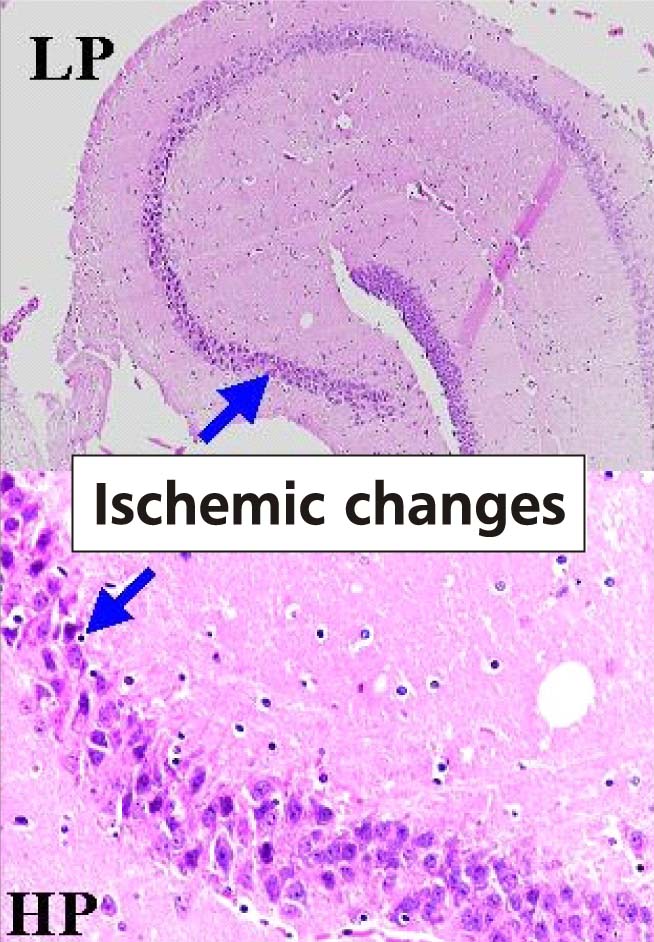
Specimen of the brain with upper end of spinal cord (cervical region) did not show significant difference for gross and microscopic changes in mice treated with AMPH alone as against those pre-treated with GBP. Serial microscopic sections from cerebral cortex, temporal lobe, midbrain, pons, medulla and upper cervical region (spinal cord) showed mild congestion with diffuse neuronal ischemia in all the regions in mice treated with AMPH alone. Also, neuronal damage was minimal but more marked in the temporal area (hippocampus) and in sections taken from the olfactory bulb in this group of mice [Fig. 1.].
Fig. 1 :Figure shows the section of mouse brain with mild ischemic changes under low power [LP] and high power [HP] microscopy in the termporal area in mice treated with AMPH alone.
Discussion
Aminophylline [AMPH] a ethylenediamine derivative used as intravenous medication in the treatment of severe bronchial asthma has a narrow therapeutic window and can induce life threatening seizures in humans.14–15 The exact mechanisms of such seizures appear to be diverse, multiple and complex, and also unclear. Evidence suggests that seizures induced by AMPH, could be the result of adenosine receptor antagonism or due to inhibition of cerebral 5'- nucleotidase activity.16–17 Both tend to lower the adenosine content in the brain and eventually lead to a process of disinhibition. However, di-phenylhydantoin a potent inhibitor of adenosine uptake was ineffective in preventing these seizures.18 Apart from non-specific adenosine receptor antagonism,19 AMPH is thought to have inhibitory influence on adenosine synthesis. At higher doses inhibition of phosphodiesterase activity including mobilization of intracellular calcium ions from labile stores are said to be implicated in AMPH-induced seizures.20-21
Several sporadic reports in literature have revealed pro-convulsant potential of AMPH, both in animals and humans.3, 22–25 A large number of studies have shown impairment of anticonvulsant efficacy of commonly used anti-epileptic drugs by AMPH in animal models of seizures.7, 8, 26 Therefore, a wide variety of agents are being investigated against experimental AMPH-induced recurrent generalized seizures, which are similar to human status epilepticus [SE] and have been demonstrated to show variable protective effects.13 Such studies support multiplicity of mechanisms involved in AMPH-induced seizures and the need to investigate effective agents against the same.
Further, AMPH-induced seizures in humans are reported to be resistant to conventional anti-epileptic medications.1–2 It is generally recognized that such seizures can occur at therapeutic or less than therapeutic levels of AMPH in patients receiving this medication for asthma.27 A single case report of a New-Zealand born Asian girl reveals pharmaco-kinetic basis for such antagonistic interaction between an anti-convulsant drug carbamazepine and theophylline, when administered for asthma and our previous studies in normal human volunteers also supports pharmacokinetic basis for such antagonistic interaction.25, 28–29
In the present study, AMPH at 280 mg/kg, produced recurrent generalized seizures, similar to human SE. Gabapentin [GBP], a Y-aminobutyricacid [GABA] analog released in 1994, for clinical use is claimed to have a multimodal mechanism of action which is said to contribute to it's anticonvulsant, anxiolytic, antinociceptive and neuroprotective actions in clinical studies.5 It is also shown to have inhibitory effects on chemically induced animal models of experimental seizures.4 The purpose of our present study was to evaluate if GBP would prevent AMPH-induced experi-mental SE. The results indicate that administration of GBP at all doses [100, 200 and 500 mg/kg] exhibited significant delay in onset of both myoclonic jerks, tonic convulsions including mortality within 120 min of observation during the experiments. Results of our study, are similar to those reported by Czuczwar et al.13 However, the anticonvulsant agents used in the said study were chemically different and also showed variable protection. The 100% mortality in 24 hr, observed in the present study is consistent with the finding of Gupta ef. al where effects of adenosine agonists and conventional antiepileptic medications were tested and failed to offer complete protection. The results of these studies together with our findings indicate fatal outcome of AMPH-induced seizures.
In addition, several studies have shown protective effects of chemically different agents including anti-epileptic drugs, tested in experimental seizures induced by xanthines13, 30 including combination of nimodipine with diazepam in petylene-tetrazole-induced SE,31 indicating involvement of multiple neurotransmitter mechanisms. Although studies have been carried out in the past using animal models of AMPH-induced recurrent generalized seizures, those exploring underlying mechanisms of GBP, are limited. Our study shows promise for development of GBP as newer anticonvulsant agent in AMPH-induced seizures model, suggesting possible involvement of GABA ergic mechanisms. A larger study can further advance our knowledge in this field.
Effects of nimodipine, a calcium channel blocker and topiramate, a newer generation anticonvulsant agent, have also been tested for their protective effects against neuronal injury induced by unilateral hippocampal electrical stimulation32 and in pilocarpine and lithium-pilocarpine-induced brain damage33respectively. However, histopathological changes following AMPH-induced SE in mice have not been reported. In a study by Dube et al12 the neuropathological changes seen in SE reflecting neuronal injury were highly significant while minimal damage was observed in our study. This difference may be attributed to the fact that in this study the effects were examined in adult rats during silent phase i.e. 14 days after SE, as against those reported in our study following SE during the acute phase. These results support the evidence that the process of epileptogenesis and its effects are duration dependent. Similar results were obtained by Niebauer et al where hippocampal injury, induced by electrical stimulation, was attenuated by chronic administration of an anti-convulsant topiramate, prior to induction of SE.
Our data validates the reproducibility of AMPH-induced recurrent generalized seizures. Further, the seizure protective ability exhibited by GBP, combined with failure to reduce 24 hr mortality, indicates fatal outcome and indicates the involvement of GABA-ergic mechanisms in AMPH-induced seizures. Further studies using chronic, multiple doses of GBP may be helpful in evolving new approaches for the treatment of SE.
Acknowledgements: We thank to Dr. Karthik Rajashekharan, NIH, Bethesda, Maryland for providing gabapentin for our experiments.
Competing interests - Non, Source of Funding - None
Received Date : 23 July 2009; Revised Date : 1 September 2009
Accepted Date : 19 September 2009
References
1. Yarnell PR, Chu NS. Focal seizures and aminophylline. Neurology 1975; 25:819-822.
2. Sigamani A, Roy AK, Yeragani VK. Profile of pharmacotherapy and pharmacoeconomics of epilepsy treatment at a tertiary care hospital. Annals of Neurosciences 2006;13(4):103-112.
3. Dunn DW and Parekh HU. Theophylline and status epilepticus in children. Nuero-peadiatrics 1991 ; 22:24-26.
4. Bartoszyk GD, Meyerson N, Riemann W,
5. Pellock JM. Treatment of epilepsy in the new millennium. Pharmacotherapy 2000; 20:129S-138S.
6. Chadwick D. Gabapentine. In New Anticonvulsants : Advances in the treatment of epilepsy. Ed. M.R.Trimble. John Wiley & Sons. New York1994; 75-90.
7. Singh M, Mishra A. Prenatal topiramate exposure induced developmental changes in rat brain. Annals of Neurosciences 2005.12(2):16-18.
8. Kulkarni C, Joseph T, David J. Influence of adenosine receptor antagonists, aminophylline and caffeine, on seizure protective ability of antiepileptic drugs in rats. Indian J Exptl Biol 1991; 29: 751-754.
9. Gupta YK and Jatinder M. Influence of adenosine agonists and anti- epileptic drugs on theophylline-induced seizures in rats. Indian J Physiol Pharmacol 1998;42:491-497.
10. Juliet J, Subramanyam K, SureshS,
11. Block F, Sieklucka M, Heim CH,.
12. Dube C, Marescaux and Nehlig AA Metabolic and the neuropharma-cological approach to the understand-ing of plastic changes that occur in the immature and adult rat brain during Lithum-Pilocarpine-induced epilepto-genesis. Epilepsia 2000; 41 (Suppl. 6):S36-S43.
13. Czuczwar SJ, Janusz W, Wamil A,
14. Bierman CW, Williams PV. Therapeutic monitoring of theophylline : Rational and current status. Clin Pharmacokinet 1989;17: 377-381.
15. Singer EP, Kolischenko A. Seizures due to theophylline overdose. Chest 1985;87:755-757.
16. Chu N.S. Caffeine and aminophylline-induced seizures: Epilepsia 1981; 22:85-95.
17. Jensen MH, Jorgensen S, Nielsen H, et al. Is theophylline-induced seizure in man caused by inhibition of cerebral 5»-nucleotidase activity ! Acta Pharmacol Toxicol 1984; 55:331-334.
18. Sharma A, Sandhir R. Oxidative stress after lithium-pilocarpine induced status epilepticus in mice brain. Annals of Neurosciences 2006;13(1):1-4.
19. Daval J, Nehlig A & Nicholas F. Minireview. Physiological & Pharmacological properties of adenosine : Therapeutic implications. Life Sciences 1991 ; 49:1435 - 53.
20. Neering IR and Me Burney RM. Role for microsomal calcium storage in mam-malian neurons? Nature (London) 1984; 309:158 -160.
21. Tutka P, Turski WA, Kleinrok Z,
22. Eldridge FL, Paydarfar D, Scott SC, et al.Role of endogenous adenosine in recurrent generalised seizures. Experimental Neurology 1989; 103:179-185.
23. KitanoY, Usui C,Takasuna K,
24. Dragunow M. Adenosine receptor antagonism accounts for the seizure-prolonging effects of aminophylline. Pharmacology Biochemistry & Behaviour 1990; 36:751 -755.
25. Mitchell EA, Dower JC, Green RJ. Interaction between carbamazepine and theophylline. New Zealand Med J1986; 99:69-70.
26. Czuczwar SJ, Janusz W, Szczepanik B,
27. Scheuer ML. Medical aspects of managing seizures and epilepsy: In Pedley TA, Meldrum BS, Eds. Recent advances in epilepsy. London, Chrchill Livingstone 1992; 5:127-157.
28. Kulkarni C, Vaz J, David J,
29. VazJ, Kulkarni C, David J,
30. Kulkarni C, David J & Joseph T. Anticonvulsants delay the onset of aminophylline- induced seizures in conscious rats. Ind J of Physiol & PharmacoM 992; 36:43-46.
31. Khosla P and Pandhi P. Anticonvulsant effect of nimodipine alone and in combination with diazepam on PTZ-induced status epilepticus. Indian J Pharmacol 2001 ; 33:208-211.
32. Niebauer M, Gruenthal M. Topiramate reduces neuronal injury after experimental status epilepticus. Brain Research 1999; 837: 263-269.
33. Marinho MMF, De Bruin VMS, De Sousa FCF,
(c) Annals of Neurosciences.All Rights Reserved